Source Aluminum Steel Infusion Trolley for Hospital and Clinic
Find 30 aluminum steel infusion trolley models designed for hospital and clinic environments. Compare features like swivel casters, ABS frames, and customizable drawer options to select the right patient care equipment for your facility; compare the available evidence and request quotations based on your requirements.
Key considerations
Products List




Comprehensive Sourcing Guide
Aluminum Steel Infusion Trolley Sourcing Guide
Procurement teams must first distinguish between standard and customized configurations when evaluating aluminum steel infusion trolleys, as the market offers both non-customized and fully customized options. The observed product range includes specific models like ITT850 and AT-850-1, which feature distinct dimensions such as 750480930 mm or 8505201300 mm, requiring buyers to match physical constraints with their facility's layout. Understanding these baseline specifications is critical before engaging with suppliers, as the frame composition often combines aluminum, steel, and ABS engineering plastic to balance durability with weight.
Buyers should also verify the intended application environment, as these units are primarily designed for hospital and clinic settings where hanging infusion bags and patient care are central tasks. The observed listings indicate that some units come with optional features like extension tables, waste bins, and needle boxes, while others focus on basic mobility with swivel casters. This variation means that a single procurement order might require a mix of standard carts for general wards and specialized trolleys for high-acuity areas, necessitating a clear definition of functional requirements before finalizing the purchase.
Product Scope and Observed Listing Signals
The current market signals reveal a diverse array of product attributes, including color options like blue and drawer configurations ranging from one to four units. While some listings specify a "New" condition with a one-year warranty, others claim a lifetime warranty, creating a significant variance in perceived value and long-term reliability. The presence of luxury universal plug-in mute wheels suggests a focus on noise reduction in quiet clinical environments, yet buyers must confirm if these specific castor types are standard or optional upgrades for their specific model selection.
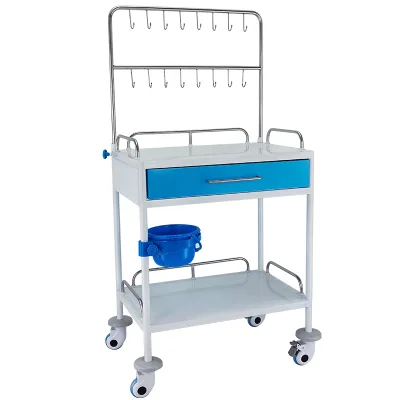
Observations also highlight that the number of hooks can vary between six and ten, directly impacting the trolley's capacity for managing multiple IV lines simultaneously. The material composition is consistently noted as ABS, aluminum, and steel, but the specific ratio and thickness of these materials are not always detailed in general listings. Consequently, procurement officers must scrutinize individual product descriptions to ensure the structural integrity meets the demands of heavy daily use, particularly regarding the four plastic steel column bearing support system mentioned in several high-confidence facts.
Technical Specifications to Verify
Dimensional accuracy is paramount when selecting an infusion trolley, as observed sizes range from compact units like 6505001500 mm to larger variants reaching 8306401500 mm. Buyers must verify that the selected model fits through standard doorways and into patient rooms without obstruction, as the listed standard sizes often differ from the actual product dimensions. It is essential to cross-reference the model number, such as ITT003 or JDESE254, with the specific height and width requirements of the facility to avoid logistical bottlenecks during installation and daily operation.
The braking mechanism and wheel configuration require rigorous verification, as some units are equipped with four castors including two with brakes, while others may lack this critical safety feature. The presence of an extension table is another variable that must be confirmed, as it significantly alters the utility of the cart for medication preparation or patient monitoring. Additionally, the drawer color options, which can be multipal or customized, should be aligned with hospital color-coding protocols to ensure efficient workflow and easy identification of medical supplies during emergency situations.
Compliance and Safety Documentation
While specific certification status like CE is noted in background data, buyers must explicitly request and verify current compliance documentation for every batch of aluminum steel infusion trolleys purchased. The absence of a guaranteed certification in the primary product facts means that relying on general market assumptions is risky; instead, procurement teams should demand valid test reports and safety certificates that confirm the materials meet international medical device standards. This verification step is crucial to ensure that the ABS plastic and metal alloys used in the frame do not release harmful substances or fail under clinical stress.
Safety features such as the mute wheels and stable column bearing support must be validated against local hospital safety regulations to prevent accidents during patient transport. Buyers should also confirm that the warranty terms, whether listed as one year or lifetime, are backed by a clear service agreement that covers manufacturing defects and structural failures. Without explicit documentation of these safety and compliance measures, the risk of liability increases, making it imperative to secure written guarantees from the supplier before finalizing any commercial transaction.
Cost Drivers and Commercial Terms
The observed price range of 98 to 730 USD indicates that cost is heavily influenced by the level of customization and the specific configuration of features like drawers and hooks. Buyers must understand that lower-priced units often lack advanced features such as the extension table or specialized waste bins, while higher-priced models may include lifetime warranties and premium castor systems. This variance requires a detailed cost-benefit analysis to determine whether the additional expense for a customized unit with a lifetime warranty justifies the long-term operational savings and reduced replacement frequency.
Minimum Order Quantity (MOQ) requirements also play a significant role in the total cost of ownership, with observed values ranging from one to ten sets. Some suppliers may enforce a strict MOQ of ten sets, which can impact the budget for smaller clinics or pilot programs, whereas others offer flexible ordering starting from a single unit. Procurement teams should negotiate these terms carefully, considering the potential for bulk discounts if the order volume exceeds the standard MOQ, while ensuring that the lead times and packaging methods, such as carton packaging, do not add hidden costs to the final delivery.
Supplier Qualification and Quality Control
Supplier qualification should focus on verifying the origin of the products, as observed listings indicate origins in China and specific regions like Hebei, which may affect shipping logistics and quality consistency. Buyers must assess the supplier's ability to maintain the "New" condition of the products and ensure that the aluminum steel construction meets the specified engineering standards. It is advisable to request samples or third-party inspection reports to validate the quality of the ABS plastic and the durability of the steel columns before committing to a large-scale order.
Quality control processes must include a thorough examination of the finishing details, such as the drawer color customization and the smooth operation of the swivel casters. Since the product features include easy cleaning and corrosion resistance, buyers should verify that the surface treatments are applied correctly to withstand frequent disinfection in hospital environments. Establishing a clear quality assurance protocol with the supplier, including pre-shipment inspections and post-delivery support, is essential to mitigate the risks associated with varying product standards and to ensure consistent performance across the entire fleet of infusion trolleys.
Long-Term Procurement Checks
Long-term procurement strategies must account for the maintenance requirements and warranty duration, as observed data suggests maintenance periods of up to five years and warranties ranging from one year to a lifetime. Buyers should prioritize suppliers who offer comprehensive after-sales support and clear guidelines for maintaining the trolley's structural integrity and functional components over time. This proactive approach ensures that the investment in aluminum steel infusion trolleys remains viable and that the equipment continues to meet clinical standards throughout its intended lifespan.
Regular audits of the deployed trolleys are necessary to monitor wear and tear on critical components like the brakes, wheels, and drawer mechanisms. Procurement teams should establish a schedule for inspecting the condition of the carts, checking for signs of corrosion or structural fatigue that could compromise patient safety. By maintaining a detailed record of maintenance activities and warranty claims, organizations can better predict replacement cycles and negotiate more favorable terms with suppliers for future procurement needs, ensuring a sustainable and cost-effective supply chain for medical equipment.
FAQs
What materials are used in the aluminum steel infusion trolley frame?
The frame is constructed from aluminum, steel, and ABS engineering plastic. This combination ensures structural durability while keeping the unit lightweight for easy maneuverability in clinical settings. The materials also support corrosion resistance and facilitate simple cleaning procedures required in hospital environments.
Can the number of drawers be customized for specific needs?
Yes, the number of drawers is available in optional configurations of one, two, three, or four units. This customization allows healthcare facilities to tailor storage capacity to their specific workflow requirements. Drawer colors can also be selected from multiple options or customized to match facility branding.
What are the standard size specifications for the large model?
The large model, identified as model ITT850, measures 850 by 520 by 950 millimeters. Other variants like ITT003 and ITT004 offer different dimensions such as 750 by 480 by 1300 millimeters or 810 by 520 by 1480 millimeters. These sizes accommodate various hospital room layouts and storage needs.
How many infusion hooks are included on the trolley?
The trolley typically includes six or ten infusion hooks, with some models featuring ten hooks as standard. These hooks are designed for hanging infusion bags securely during patient care. The attachment points are integrated into the frame structure to ensure stability and ease of access for medical staff during treatment procedures.
What type of wheels are fitted to the medical trolley?
The trolley is equipped with luxury universal plug-in mute swivel casters. These wheels include four pieces in total, with two featuring brakes for secure positioning. The mute design ensures quiet operation in sensitive hospital environments, while the swivel capability allows for smooth and precise maneuvering through narrow corridors.
Is the product suitable for use in clinics and hospitals?
Yes, the trolley is specifically designed for applicable scenes including hospitals and clinics. It supports patient care tasks such as hanging infusion bags and managing medical supplies. The durable ABS and metal construction ensures it meets the rigorous hygiene and usage standards required in professional medical facilities for daily operations.